Hijab-less by Choice, Muslim Women in Their Own Words

NPR: Lifting the Veil

It’s always so powerful and inspiring for me to hear people tell their own stories in their own words. Included in the multimedia presentation for this NPR story are 12 Muslim women explaining their choice to unveil. So many of the themes of doubt and questioning and negotiating recounted in their stories resonate with me even as I choose to continue wearing hijab.

Kim Joseph, a convert to Islam, remembers that before she even took her shahada, the phrase which one utters to enter into the faith of Islam, the Muslim women around her put a hijab on her head. She wasn’t even Muslim! It seems the priorities were mixed up. And Joseph now says without hijab, she is able to “develop her faith from the inside out rather from the outside in.” I don’t think there needs to be dichotomy between the external and internal parts of faith, yet when the internal meshes with the external, they seem to reinforce each other. Before I converted to Islam, when I was simply delving into learning about the faith, I test drove several mostly unorthodox hijab styles. I just wanted to see what it’d be like to wear hijab were I to convert to Islam.

Sana Javed looked familiar to me, she attended the University of Maryland and was involved with the on-campus Muslim events so I’ve probably have seen her around. She expresses a sentiment that is felt by many, that as long as you look the part of the ideal muslimah, hijab and demeanor, it’s all good but once you challenge those stereotypes, you can expect a wave of negativity directed at you to force back into the orthy box. Hijab in  that sense, is seen as a “litmus test” for one’s piety. Which brings up the issue of the assumptions and expectations that go along with wearing hijab.

Hijab is a religious, political, and social statement. It means different things to different people but no doubt those many statements, assumptions, and expectations come to the fore. People, both Muslim and non-Muslim often see the hijab before the woman. For some, this is preferable and desirable and for others it becomes a burden, a hindrance, and brings much unwanted attention. And for some of us, hijab is a little bit of both. Samia Naseem mentions how she actually feared for her safety while wearing hijab in this sometimes hostile environment post 9-11. And I think it’s important not to diminish these voices, a garment that is supposed to offer a form of protection does also quite visibly at times put women at risk of physical harm and abuse. Despite her own choice, Naseem doesn’t want her unveiling to be used as support or encouragement for other Muslim women to unveil. The choice, which every woman should be free to make is deeply personal.

For Rasmieyh Abdelnabi, wearing hijab is akin to being forced to be a public and visible representative of the Muslim community at all times, which is not a role every woman wants to assume for herself. It’s remarkable how easily many Muslim men can blend in and are even encouraged to blend into society, to not stick out, and live public lives nearly indistinguishable from the non-Muslims around them. For Muslim women, one of the only ways to do that is by choosing not to wear hijab.

Nadia Shoeb expressed that she felt naked the first time she went outside without her hijab as if she had gone shirtless. I think this is something many of us can relate to, either being asked to remove our hijab in public or having a man unexpectedly walk in on us without our hijab. Such an experience can be deeply embarrassing or humiliating. Shoeb also noted something interesting, that the experience of these Muslim women chronicled in the story is “distinctly American.” Continue reading

I Do Not Support the Burka/Niqab Ban

So France has banned the burqa/niqab. I blogged about showing some niqab solidarity way back in 2006. That post, which I had forgotten about is now trending on my blog so I decided to re-read it. So many promises made, ones that should be kept:

I promise not to judge people by their clothing. I promise to defend the right of women to decide for themselves how they wish to dress. I promise to not take any positive or negative experiences I have had with sisters dressed a certain way to extrapolate and make generalizations about them or others with similar fashion choices. I promise to not sit idly by while people try to force you to uncover or cover to fit their perceptions of modesty.

More than four years later, my views on niqab have shifted. At some point after my conversion, I flirted with the idea of wearing niqab but ultimately decided against it even though I had purchased several Saudi-style over-the-head abaya/niqab outfits. I never wore them outside of my house. I tried them on but found them completely unwieldy. My peripheral vision was diminished, it would have taken some getting used to the everyday walking, sitting, driving, and praying, especially getting up from prostration. And certainly, my family already not particularly enthused with my decision to wear hijab would not have been pleased. Oh, but isn’t it about pleasing God, first and foremost? Perhaps, and yes, ideally, but there’s often a great deal of people-pleasing that goes into our clothing choices, and this is true for Muslims and non-Muslims, both secular and religious.

I believe my decision to wear hijab and abaya was primarily motivated by a desire to increase in my God-consciousness. The decision wasn’t well-received by those closest to me and at that time my main contact with Muslims was through online forums. When I was thinking about wearing niqab, I asked some other niqabis for their advice and input, I was curious about their experience and feelings regarding their choice. One sister in particular, who no longer wears niqab, advised me not to wear it out of the communal pressure that sort of “niqab is better and more pious” talk that permeates many conservative communities.

In the end, I didn’t feel then and don’t feel now that niqab is obligatory or even preferable. I don’t think it would bring me closer to God nor do I think it’s necessary go to such an extreme (for me) level of covering in order to simply exist as Muslim woman in society. The struggle for some of us is to blend our cultural identities with our clothing choices. We want to dress modestly but  neither wish to look “weird” nor assume cultural practices alien to our own culture.

However, my personal feelings are beside the point. To force a woman to cover or uncover has nothing to do with justice and liberal values. Yes, women are forced to cover and they are also forced to uncover every single day by other Muslims and by non-Muslims and that’s really very sad and something we should all strive against. But the way to do it, is not by limiting choice and freedom, even if we disagree with those choices.

I’ve been in several situations (renewing my driver’s license, working in a hospital, working for TSA) where I was asked or rather told that I needed to take of my hijab. That’s never a pleasant feeling and if you’re not strong or you do not know or feel able to defend your rights, you may give in to that pressure. In a similar way, I’ve been in positions where women that may not wear hijab have asked me for advice about whether or not they have to or should wear hijab in specific social situations. I tend to say, “no, you do not have to wear it” and to emphasize that it is their own personal choice and comfort which is paramount. And that I will support them in whatever they decide.

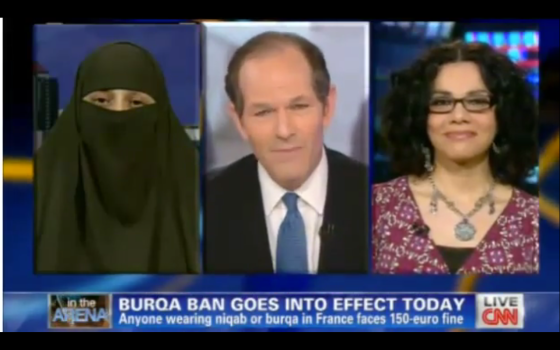
It is this support that I think is critical and often missing. The support to choose for oneself despite the pressures, which seek to remove that choice. Nice clip on CNN of a debate between Hebah Ahmed, a niqabi,  and Mona Eltahawy. For me, seeing Hebah and Mona is a victory of sorts, two Muslim women with two different ideas about dress comfortably explaining for themselves why and what they believe. I find it disturbing for someone who believes in women’s rights to try to deny women the right to choose a manner of dress for themselves. And I also find it equally disturbing that some of those who claim to support the right of women to choose for themselves in this case would quite happily deny women the right of choice if empowered in other settings.

I know there are many women who continue to wear hijab or niqab simply out of the pressure to conform despite their wishes to not wear it. And I’ve seen women forced to take off their hijab or niqab for reasons of employment or safety or unjust laws like those in France or Turkey or elsewhere. I’m for choice, yours and mine.

Previously,

Hijabi Monologues Review

Drop-Top Convertible Hijab

Caryle Murphy, Yasir Qadhi, & the Headscarf

An Igbo Muslimah Like Me – One Convert’s Story

By Miriam, a graduate student in Philadelphia crossposted at Muslim Matters

You may see me in the crowd in my community saying, “kedu” (hello) or chanting “eh” after “Igbo Kwenu” (“Igbos speak”). On the outside, I am your typical Igbo-American girl. However there is nothing typical about me – I am Igbo and a Muslimah (gasp!). Shock to you? Perhaps not, but to many in my community it is. Many Igbos and even Nigerians claim that “there are no Igbo Muslims.” Well, sorry to break it to you, but I am living proof that I am full Igbo and a practicing Muslim. When I tell Igbos that I am a Muslim, I frequently hear “tifaqua” (God forbid!). I am not married to a Muslim (a common thought among many) nor was I tricked into the faith by a fellow Muslim. I converted (alhamduillah) because I felt like this was the right path for me – to convert to another faith- the same convictions that drove my forefathers before me to convert to Christianity.  Others may claim that “Islam is not compatible with Igbo culture,” yet I challenge them to prove that Christianity was more compatible than our traditional indigenous beliefs that preceded it for thousands of years. What many fail to realize is that we are a product of our environment. If Buddhists took control of Igbo land, we would most likely be Buddhist and still strong in that faith and conviction. My challenge for everyone reading is to analyze why you believe what you believe – and to respect and agree to disagree with others who may differ.

To be a Muslim in my community is difficult – not impossible, but challenging. Many of our practices, cultures and beliefs rest heavily on Christianity, even though Christianity arose among the Igbos in the 1900s. In fact, my great grandfathers were not Christian. How do I come to terms with cultural beliefs such as reincarnation? This belief is ingrained in my people. Even my grandfather, a Christian, believes in reincarnation – even though it goes against the principles of Christianity. Are masquerades (symbolizing the dead) halal? Is breaking the kola nut (see a kola nut ceremony) a preservation of my rich culture or an abomination in the eyes of Allah (subhanahu wa ta ala)? How can I find a happy medium yet preserve my identity as an Igbo?  Today, this still remains a challenge. I am still trying to find a community – even if small- of people of my own ethnic background. Are there people like me? I asked myself, “do Igbo Muslims exist?” Frustrated, I scoured the internet for anything – ANYTHING that would reassure me that there were people like me. Alhamduillah, I came across this blog – about an Igbo Muslimah convert. I contacted Ify immediately and soon we became friends.

While I expected hostility from my own community, I am somewhat dumbfounded and shocked by the treatment that I have received from some born Muslims. This is certainly not an attack on the fellow Muslims who have embraced me and provided support, but rather a critique of the way some born Muslims interact with converts. You never know who might be a new Muslim – one may have converted only a few hours before your encounter. Your interaction can either help a new Muslim embrace their faith or help them leave it. Continue reading

Ilm Summit | Behind the Scenes of the CNN Interview

In my earlier post on Deborah Feyerick’s story partially filmed at Ilm Summit this past August, I mentioned I would blog about some of the behind-the-scenes happenings. After interviewing the various instructors at Ilm Summit, counterterrorism expert and occasional Muslim Matters’ contributor Mohamed Elibiary helped arranged an interview with bloggers from Muslim Matters.

Meanwhile, I was eagerly awaiting the start of that night’s wild card session with Jamaludeen Zarabozo. A respected and self-taught convert to Islam with extensive knowledge of the Islamic sciences, his classes and books are popular in conservative Muslim circles. It was expected that he would share some of the key elements of his story of conversion and how he learned the Islamic sciences with us.

I was all set to learn something new and take notes and just as Zarabozo sat down to begin, someone came up to tell me or passed me a note (should have written this earlier, memory is now a bit hazy) that my presence was requested outside the banquet hall, which had been converted into our classroom. I was pretty disappointed to be leaving the session I had most looked forward to all day especially as I was not at all sure of what was in store for me outside. As it turned out there was a bit of a Muslim Matters huddle, preparing for an interview opportunity with CNN on a story about online efforts within the Muslim community to counter the message of extremism.

Courtesy of MM

So often in the media, Islam is represented through the voices of men so it was seen as desirable to have at least one woman join in the interview and that’s how I ended up there as the token Muslim woman. I was a bit anxious to return to the wild card session, now in progress, but was somewhat resigned to the fact that I would miss it. Perhaps, I could have caught the end of it had there not been some miscommunication. For what seemed like at least 20 minutes or more, both the MM team and the CNN team were sitting near each other at tables in the cavernous lobby. As it turned out, we were both waiting for the other group to signal readiness to commence the interview.

Once it was sorted out that both sides were ready, a few awkward moments soon followed. I didn’t intend to wear my black AlMaghrib hoodie but the videographer wasn’t sure where or how to clip on my microphone due to my hijab. So I quickly put my hoodie back on and he worked out the mic issue in a way that made me acutely uncomfortable threading the mic over my clothes and hijab but under the hoodie. I thought to myself, is this what I’m missing the wild card for? I then made a mental note to always do the microphone myself and most likely could have worked out clipping it to my hijab. Though, I must admit the CNN mics were nice.

Next bit of awkwardness, in order to fit all four of us on camera for a wide angle shot, we had to sit rather close together. Much closer than one might sit naturally in order to maintain a level of personal space. Not much that could be done about that.

As the interview progressed my colleagues made some excellent well-packaged talking points. I don’t think I said anything extraordinary. I rambled through my first response, distracted, I briefly lost my train of thought. A small crowd of students had gathered around us to watch the interview. I just hoped someone was taking good notes inside the hall. By the time we finished, it was pretty late and Deborah Feyerick, her producer, and the videographer had had a long day but were still very cordial and gracious.

After we wrapped up the interview, I headed back into the hall but the wild card had ended. I had missed the whole session despite being prepared for it and staking out my seat in the front row, which at Ilm Summit is no small feat. To get a front row seat, one has to come early, eat quickly, leave off sleep and socializing, and sometimes negotiate with the crew from California who would like to think they own first dibs on those seats.

I asked my trusted note-taking companions about the wild card session to see if any of them had notes but none did. Continue reading