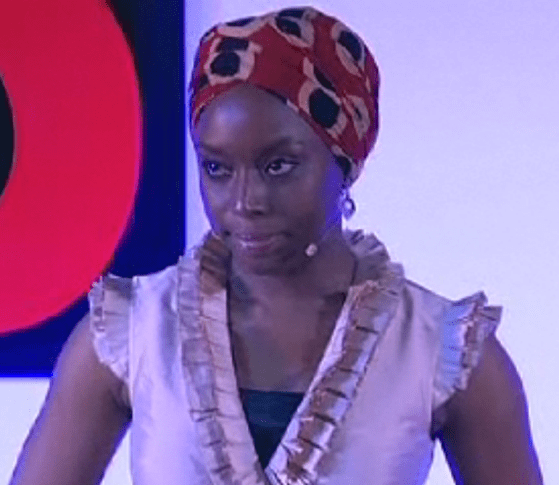
Chimamanda Adichie on the Danger of a Single Story

I’m not sure how I happened across this TED video of Nigerian author and storyteller Chimamanda Adichie but I’m so glad that I did. Much of her talk, revolving around examples pointing to the danger of having only a single story about any people or any place resonated with me.

I am Nigerian and I am American, dual-nationality granted to me as a consequence of my birth. Like Adichie, since childhood, growing up in a mostly white town in upstate New York and attending a mostly white school district, I too have been asked about Africa as though I’m supposed to be an expert about every country, historical development, and political and cultural reality on the vast continent. Oh and Africa is most certainly a continent, not a country. Please try to remember that the next time you’re mentioning a list of countries like America, Japan, Brazil, England, and Africa? No, my friend, Africa does not fit at the end of that list.

When Adichie’s American college roommate asked to listen to some of her “tribal music” I could almost see the disappointment which must have reflected on her friend’s face when she pulled out her Mariah Carey cassette tape. I remember so many conversations asking me if those Tarzan-like or Kipling-esque images of Africa still ring true. If we all dance around the fire or live next to elephants, tigers, and giraffe.

The Africa I know is one of modern people living ordinary or extraordinary lives, in houses that might resemble similar structures in any American or western suburb. Not to say there is not poverty because there is but that poverty does not define the Africa I know any more the Southeast D.C. defines the Washington DC region I know. The Africa I know is of people working hard despite the hardships, excelling in education and careers (if they are fortunate to find employment after graduation or as they migrate to foreign countries), laughter, strong familial and community ties, infused with spirituality, good traditional foods, and of Nollywood (the Nigerian Bollywood or Hollywood). The only time I remember seeing large animals commonly found in the pages of a National Geographic magazine was on a trip to the zoo in Lagos.

Like Chimamanda Adichie and Chinua Achebe and even an author with my exact name Ifeoma Okoye, I am Igbo. Their writing inspires me and provides me with examples of people like me. To return to Nigeria and to read their work fills me with a sense of coming home (even though I view my hometown as being in New York) and of understanding. It provides me with examples of people with brown skin and hair and lips and cultural nuances like mine. A much needed reference point in forming one’s identity when surrounded by a world that views Africans “with a kind of patronizing well meaning pity” as a monolith, inferior, beastly, “half devil, half child,” needing to be rescued from themselves by outsiders.

I am Igbo and I’m Muslim, a convert to Islam. Many people I encounter familiar with the Igbo will remark on how unusual or anathema the two concepts seem as the Igbo tribe post-British colonialism has become fiercely identified with Christianity. And in the never-ending battle of tribal one-upsmanship juxtaposed to other tribes, particularly the Muslim ones.

To be a convert in American Islam, even with its diversity is kind of like growing up in a predominantly white town. Very rarely do you see authentic representations of oneself and one’s story. Continue reading

Andrea Elliott, Yasir Qadhi | Talk about American Muslims, Jihad & Good and Bad Salafis

Disclaimer: I am quoted in this article.

Andrea Elliott has written a revealing profile of Yasir Qadhi, an influential teacher and imam amongst some conservative western Muslims. Overall, I think Elliott offers the reader a fascinating window and insight into a little known and much maligned segment of the Muslim community, however, the repeated references to Salafiya seem to have missed the mark.

…But Qadhi had another life. Beyond the gothic confines of Yale, he was becoming one of the most influential conservative clerics in American Islam, drawing a tide of followers in the fundamentalist movement known as Salafiya

I’ve never been fond of the word “cleric” and have become even less so after reading it repeatedly throughout this article. While a cleric may rightly be defined as “any religious leader ” it seems that word is most often reserved for Muslim imams, leaders, and religious activists. Later on, more neutral terms like “theologian”  and “preacher” are used, “Arguably few American theologians are better positioned to offer an authoritative rebuttal of extremist ideology.”

I will concede that I don’t see much difference in aqidah (theology), fiqh (jurisprudence), and methodology between those who would like to be called Salafi, orthodox, or conservative. However, within many Muslim circles, the Salafi label is viewed in an exceedingly negative light and has been for quite some time. While many conservative Muslims proudly assert their claims to orthodoxy and to following the ways of the salaf, the earliest generations of Islam, due to the excesses of the Salafi movement, many reject the label Salafi for themselves. Today, the few that do still claim the Salafi title for themselves have a tendency to view people like Yasir Qadhi with his ever-evolving views (evolution, in this sense, is a good thing) as having sold-out or gone astray from the straight path of Islam. An Islam largely informed by the historical political, religious, and social mores of Saudi Arabia.

A more accurate assessment might be that Qadhi draws followers from a diverse group of largely conservative Western Muslims. His story is like so many of ours, the child of immigrants, to whom much was given and much was expected, having come of age  trying to find a balance between the competing forces of our fiercely Western and our parents’ back home identities. Fluent in the vernacular of Westerners, with a sharp and critical mind, and an engaging and lucid manner of speaking, writing, and teaching, it’s easy to love his work. I still remember the first time I heard a Yasir Qadhi lecture. A friend had given me his The Story of Ifk about the slander of Aisha and I was immediately drawn into the story, captivated, I listened to all four parts. Not only did Qadhi have flawless English, a sometimes rare but important quality but he told the story with such detail and intensity that one could not help but be moved. Afterward, I remember asking my friend for the name of the speaker so I could find more of his lectures online.

In the basement of the religious-studies building, Qadhi settled into an empty room, flipped open his MacBook Pro (encased in Islamic apple green) and dialed in to an Internet conference call with more than 150 of his AlMaghrib students. “I want to be very frank here,” Qadhi said, his voice tight with exasperation. “Do you really, really think that blowing up a plane is Islamic? I mean, ask yourself this.”

Photo courtesy of Todd Heisler/The New York Times

Islamic apple green? C’mon, it’s just a green case. I have a blue one, one of my friends has a green one, nothing Islamic or religious about it but interesting detail with a picture amongst the interactive features. Continue reading

Ali Asad Chandia Re-Sentencing Hearing | Justice Delayed for a Third Time

At Dar us Salaam, waiting to carpool to the courthouse on January 28, 2011.

On Friday, a group of concerned Muslims and I began a ritual, which has become all too familiar over the past seven years. We wake up early and meet at a local Muslim school, which serves as the gathering point for carpools or for trips to the metro as we make our way down to the Federal District Courthouse in Alexandria, VA so that we can fill the courtroom before each hearing, usually scheduled to begin at 9am.

Strange how familiar the courthouse is and the newly revitalized section of downtown Alexandria that surrounds it. So many memories. I remember praying outside in the courtyard, as pictured below, while the now finished nearby buildings were still under construction. And of being taunted by the construction workers atop those then unfinished buildings. As I walked into the courthouse, I knew the drill, leave your cell phone in the car (when we first starting coming here seven years ago, courthouse security would take your phone and give you a number so you could retrieve it later on), don’t wear heels, which will set off the walk-through metal detector, if you’re a woman wearing niqab, the full face-veil, come a little early as they might have to find a female guard to view your face, coats and jackets off, and photo ID out and ready for the security screener. On Friday, I handed my driver’s license to an older and very polite gentleman who then tried unsuccessfully to pronounce my last name but said rather joyfully, “Good morning, I remember you!” and indeed, I remember him and his colleagues well, many of the same faces that have been here for each trial over the last seven years.


You can't see us but we're there praying behind the men, years ago, after one hearing.

Tensely, we waited until we were all through security, and then made our way to the elevators, no need to check the courtroom assignments, Judge Claude Hilton is on the 8th floor, Judge Brinkema is on the seventh and so on…Beginning the day’s proceedings was the usual court business of sentencing and something of a novelty, which many of us had not yet witnessed. Two new graduate lawyers were admitted to the bar in a short courtroom ceremony, their colleagues introduced them, their schools, and testified to knowledge of their upright character, and Judge Claude Hilton admitted them. Both men seems relieved and happy. Good luck to them, may their work be filled with the dignity and integrity, which is a credit to their profession.

Then it was Ali Asad Chandia’s turn. He was escorted in by federal marshals and wore a dark green jumpsuit with the words prisoner written in white letters across his upper back. Chandia was convicted in 2006 of providing material support (shipping paintballs, driving an LET official around the DC metro area and allowing him to use his computer) to Lashkar-e-Taiba (LET), designated as a terrorist organization by the U.S. State Department. Judge Claude Hilton applied a terrorism enhancement at the original sentencing, which increased Chandia’s sentence from what would have normally been around six years to 15 years. However, in order to apply a terrorism enhancement, Judge Hilton is required to demonstrate that Chandia’s actions were intended to “influence a government through intimidation or coercion or to retaliate against a government.” It is on this latter requirement that the 4th Circuit Court of Appeals has twice ruled for Chandia and against Judge Hilton indicating that the Appeals Court does not believe the use a terrorism enhancement is justified in this case.

On January 28th, 2011, Judge Hilton was clearly hostile to the defense attorney Marvin Miller. Hilton indicated his frustration while rocking back and forth in his chair by saying before Miller began his argument that “this is starting to be a career for me, think I’d hear the same thing I heard the first two times, I’d like to know what will be different.” About proposed revisions to the pre-sentencing report, Hilton said, “I listened to this twice, don’t think any other arguments will benefit me” Continue reading

Have You Seen a Leaf with a Single Drop?

UPDATED: Deleted the other stock image and have now included actual leaf picture we saw that day.

At the hospital today, got introduced to the leaf with a rain or tear drop sign on a patient’s door, which signifies a loss related to pregnancy. The door was partially open but it was so quiet in there, it was like the grief was radiating out towards us. That mother would not be taking her baby home with her. Devastating.

The leaf did not look like this picture. It was a single leaf in a shape similar to a slightly cupped hand with a single full and rounded drop towards the end. Somehow, the picture seemed apt, yet, I wonder how it is for that family when they see that picture. Although the picture is discreet, obviously, you don’t want staff or students coming in and asking, “so how’s the baby doing?”  it still seems to magnify the loss. It certainly magnified it for us.

This slideshow requires JavaScript.

Stop the Hate, Evolution, & Why We Care about Issues

Haters never Prosper

In Orange County, California (remind me to strike that off my places to visit other than to show my support for the Muslims there), the worst and the lowest of anti-Islam protestors showed up to a fundraiser organized by a Muslim organization to raise funds for women’s shelters and to aid in the general fight against hunger and homelessness here in America. They were greeted by politicians, tea party activists, and a group of protestors akin to the repugnant Westboro Baptist Church members who protest at the funerals of dead military personnel.

Now, I’m a big free speech advocate even if that speech is offensive and it may reflexively feel good to prevent it. I agree with the Supreme Court’s decision yesterday protecting the right of expression and don’t agree at all with the implementation of so-called blasphemy laws in some Muslim countries, which are largely used as tools of injustice to persecute minorities or political opponents, which even if there is some basis in the religion, was never the intent of law.

Here’s the video, not for the faint of heart, of the protestors harrassing the Muslim attendees at the fundraiser. I hope and pray each elected official that spoke at the rally is voted out of office or recalled by the people and for understanding and civility to enter the hearts of the protestors.

The Theory of Evolution

I made some comments on Muslim Matters in response to a comment indicating that Muslims find the theory of evolution to be a heresy. Among other comments on that post about the assassination of Salman Taseer in Pakistan, I said the following, “I neither think that parts of the theory of evolution are a heresy nor blasphemy laws as we see implemented today for a plethora of reasons should be considered a part of religion.”

I didn’t make those comments lightly or flippantly. However, some critics, reading in their own biases then interpreted those comments to mean that I have given full and unconditional support to Darwinian (where did I say Darwinian?) evolution. Did we miss the word “parts” used as a limited qualifier?  Many conservative Muslims find Darwin’s theory of evolution to be incompatible with Islamic theology and the story of the creation of human beings. To what extent one accepts or rejects evolution is controversial. However, for me, learning and working as I do in the healthcare field, parts of the theory of evolution, Darwinian or otherwise, is simply incontrovertible, that some organisms do evolve and there seems to be a form of natural selection at play.

One can always disagree about anything, pseudoscience is there for the taking but real science confirms (as it can in its limited way) the existence of newer strains of antibiotic resistant bacteria for example common in TB patients and of methicillin-resistant Staphylococcus aureus (MRSA). I’m currently doing a unit in maternal nursing and women’s health. Have you ever seen a child born with genetic mutations incompatible with life? Continue reading